Charles and Ray Eames: The Furniture and How They Made It
Charles and Ray Eames were an American husband-and-wife design partnership who worked together from 1941 until Charles died in 1978. He had trained as an architect in St. Louis, she as a painter in New York, and over thirty-seven years the office they ran in Venice, California produced furniture, a house, exhibitions, toys and more than a hundred short films.
The furniture is what most people know them for, and nearly all of it descends from a single technical problem they solved during the Second World War. Asked to improve on the metal leg splints then issued to wounded servicemen, they worked out how to bend plywood in two directions at once. Every plywood chair they later built, and the moulding logic behind the fiberglass and wire chairs that followed, came out of that work.
This article sets out their training and partnership, the way the office approached a design problem, the techniques they developed, the individual pieces those techniques produced, and where the designs stand now.
Charles & Ray Eames: Quick Facts
- Charles Ormond Eames Jr.: born 17 June 1907 in St. Louis, Missouri. Died 21 August 1978.
- Ray Eames: born Bernice Alexandra Kaiser, 15 December 1912 in Sacramento, California. Died 21 August 1988, ten years to the day after Charles.
- Married: 1941 in Chicago, moving to Los Angeles immediately afterwards.
- Training: Charles at Washington University in St. Louis. Ray under Hans Hofmann in New York, 1933 to 1939. Both at Cranbrook Academy of Art.
- Office: 901 Washington Boulevard, Venice, California, 1943 to 1988.
- Materials: moulded plywood, moulded fiberglass, welded steel wire, cast aluminium.
- Principal works: the moulded plywood chairs of 1946, the fiberglass shell chairs of 1950, the Lounge Chair 670 and Ottoman 671 of 1956, the Aluminium Group of 1958, the Eames House, and the film Powers of Ten.
Table of Contents
- Who Were Charles and Ray Eames?
- Who Was Ray Eames?
- How a Medical Splint Produced a Chair
- How the Eames Office Defined a Chair
- The Furniture, in Order
- The Moulded Plywood Chairs
- The Shell Chairs and La Chaise
- The Wire Chairs
- The 1956 Lounge Chair and Ottoman
- The Aluminium Group and After
- The Eames House
- Films and Exhibitions
- Where the Designs Stand Today
- Frequently Asked Questions

Who Were Charles and Ray Eames?
Charles Eames was teaching at Cranbrook Academy of Art in Michigan when Ray Kaiser arrived there as a student in the autumn of 1940. He was thirty-three, an architect who had run a practice in St. Louis through the Depression and had come to Cranbrook on a fellowship two years earlier. She was twenty-seven and had spent most of the previous decade in New York, studying painting and exhibiting with a group of abstract artists. They married in Chicago in 1941, drove west, and set up in a rented apartment in Westwood, where the spare bedroom became a workshop.
What did Charles Eames do before the partnership?
He studied architecture at Washington University in St. Louis and left without completing the degree, then spent the 1930s running a small architectural practice in the city. In 1938 a fellowship took him to Cranbrook, where he stayed on to head the industrial design department.
It was there that he met Eero Saarinen, and in 1940 the two of them entered the Museum of Modern Art's Organic Design in Home Furnishings competition with a group of moulded plywood chairs. Their entry won. No manufacturer could then produce the pieces at a sensible cost, since bending plywood into a compound curve remained an unsolved industrial problem, and that gap between a winning drawing and a manufacturable object set the work of the next six years.

What was the Kazam! machine?
The press they built in that spare bedroom, assembled from scrap timber and a bicycle pump. A sheet of veneer went into a mould, a layer of glue went on top, and the two steps were repeated between five and eleven times depending on the piece. The machine then clamped shut and the bicycle pump inflated a rubber balloon inside it, forcing the stack against the form until the glue cured. The finished shape was cut out with a handsaw and the edges sanded by hand.
Charles named it for the moment the piece came free of the mould, which he described as happening "ala Kazam!, like magic". It cost almost nothing to build and it let them test a new curve overnight, which mattered a great deal to two people working without a factory.
Who Was Ray Eames?
Ray Eames was born Bernice Alexandra Kaiser in Sacramento on 15 December 1912. She enrolled at Hans Hofmann's painting school in New York and studied there for six years, from 1933 to 1939, in a circle that included Lee Krasner and Mercedes Matter. In 1936 she became a founding member of the American Abstract Artists, and her paintings hung in the group's first exhibition the following year.
She reached Cranbrook in 1940 and worked on the drawings for the Organic Design entry within weeks of arriving. After the marriage her painting largely stopped, at least in the conventional sense, and her former colleagues in New York noticed.
What did Ray Eames contribute to the work?
Charles answered this himself in a presentation given in 1952. Asked why his wife no longer exhibited, he said that she was a painter, "and a very good one", and that she had been "consistently functioning as a painter on architecture as much as anything else". The colour, the proportion and the resolution of the compound curves were her territory, and those are the properties of an Eames chair that a person registers without being able to name.
Her covers for Arts & Architecture magazine ran through the 1940s, and several forms that later became furniture appear on them first. The magazine belonged to John Entenza, who financed the splint work, published the Case Study House programme and built the house next door to theirs, so her graphic work and the office's architecture were never really separate activities.
Why is Ray Eames often left out of the record?
The name reads as male to many people, and the press of the period habitually credited the man in a partnership. The clearest instance is not a magazine but a museum. When the Museum of Modern Art presented the plywood chairs in June 1946, work the two of them had developed together over five years, the exhibition was titled New Furniture Designed by Charles Eames.
The correction has come mostly from the archive. The Library of Congress holds roughly a million items from the office, and the Smithsonian's Archives of American Art recorded an oral history with Ray over three weeks in the summer of 1980, which remains the fullest account in her own voice.
How a Medical Splint Produced a Chair
In 1942 the Medical Corps had a problem with leg splints. The metal ones then in service transmitted vibration while a wounded man was being moved, and the vibration was causing further injury. The Eameses had spent two years learning to bend plywood in three dimensions and could see that a moulded wooden splint, shaped to the contour of a leg, would carry no vibration and weigh very little.
They took the shape from Charles's own leg, casting it directly. Removing the finished cast reportedly took all the hair off with it.
Why does the splint matter to the furniture?
Because it is the same object as the chairs, solved earlier. The splint is a compound-curved plywood shell that has to hold its form under load without splitting, which is precisely the problem an Eames chair back presents. The symmetrical holes cut into it answer two questions at once, relieving stress in the bent plywood and giving a medic somewhere to thread bandages.

Leg splint, designed 1941 to 1942, moulded plywood. Brooklyn Museum, accession 83.156, anonymous gift.
Working within a constraint rather than around it became the office's habit, and their grandson Eames Demetrios has described the splint as the clearest early example of it. He also noted what the military contract did for two designers with no money: "Although the military is not the same as a consumer market, it is still a market."
How were the splints actually produced?
Not in the apartment. Charles and Ray could not finance production, and a partnership with John Entenza and Colonel Evans of Evans Products brought both capital and a real factory. Roughly 150,000 splints were made before the end of the war, and the operation grew into the Moulded Plywood Division of Evans Products, with the Eameses developing the process and building the tooling themselves.
Other wartime commissions followed the same technique: an arm splint, a body litter, a pilot's seat, an aircraft fuselage and a stabiliser tail. By 1945, with the war ending and the office at fifteen people, they turned back to furniture.
How the Eames Office Defined a Chair
Charles set out the terms plainly. A chair, he said, "has essentially two parts, one, a surface to receive the body, and two, a structure to hold that surface in proper relation to the ground".
Almost everything the office built can be read against that sentence. The plywood chairs are two moulded surfaces on a separate frame. The shell chair is a single surface offered on a whole family of structures. The 1956 lounge chair is three surfaces on a cast aluminium base. In the Aluminium Group of 1958 the distinction finally collapses, because the surface is a panel held in tension by the structure itself.
Did they favour particular materials?
No, and they said so. The office was material agnostic, in the sense that it began with a need rather than a substance and then looked for whatever met it. The shell chair form was worked out in metal before it was ever made in plastic, and the office moved through plywood, fiberglass, wire and aluminium in fifteen years without treating any of them as a house style.
Underneath sat a commercial principle that shaped the forms as much as any aesthetic one. Fewer parts meant a better chair at a lower price, so reducing the part count was a design objective rather than an economy.
The Furniture, in Order
Read as a sequence, the material changes about every four years and each move follows from a limit the last one exposed. Plywood could not be pressed into a single body, so the fiberglass shell answered that. The shell could not be upholstered without losing its point, so wire frames carrying separate pads answered that. Those pads led to the 1956 chair, and the tensioned panel of 1958 removed the frame beneath the seat altogether.
| Piece | Year | Material |
|---|---|---|
| Moulded plywood leg splint | 1943 | Moulded plywood |
| LCW and DCW, wood-legged | 1946 | Moulded plywood, rubber shock mounts |
| LCM and DCM, metal-legged | 1946 | Moulded plywood, chromed steel rod |
| La Chaise | 1948 | Moulded fiberglass, steel, oak |
| Eames Storage Units | 1949 | Zinc-plated steel, plywood, masonite |
| Moulded fiberglass shell chairs | 1950 | Reinforced polyester, steel bases |
| Wire mesh chairs | 1951 | Welded steel wire |
| Hang-It-All | 1953 | Steel wire, lacquered wood |
| Lounge Chair 670 and Ottoman 671 | 1956 | Moulded rosewood plywood, leather, cast aluminium |
| Aluminium Group | 1958 | Cast aluminium, tensioned fabric or leather |
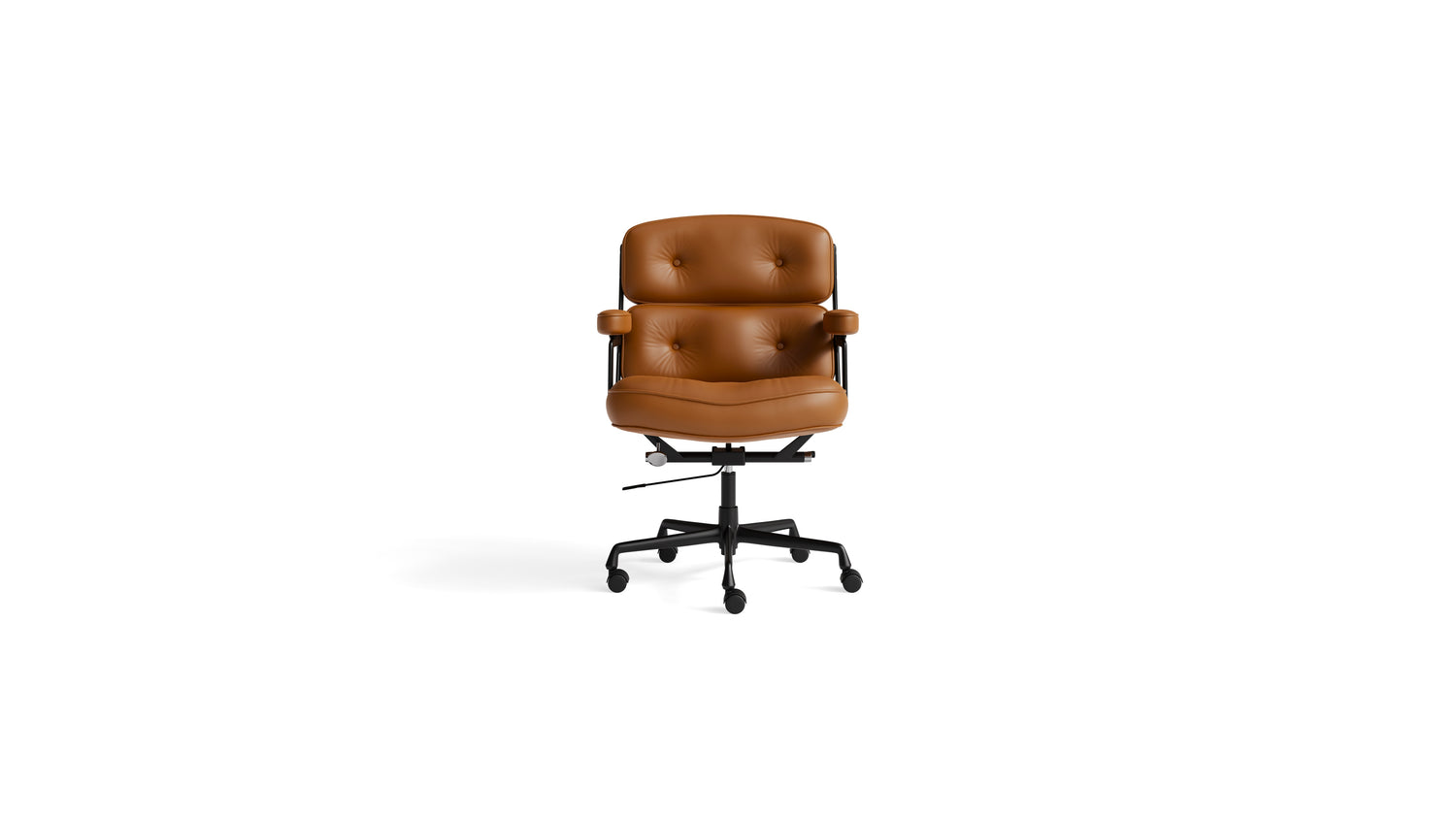
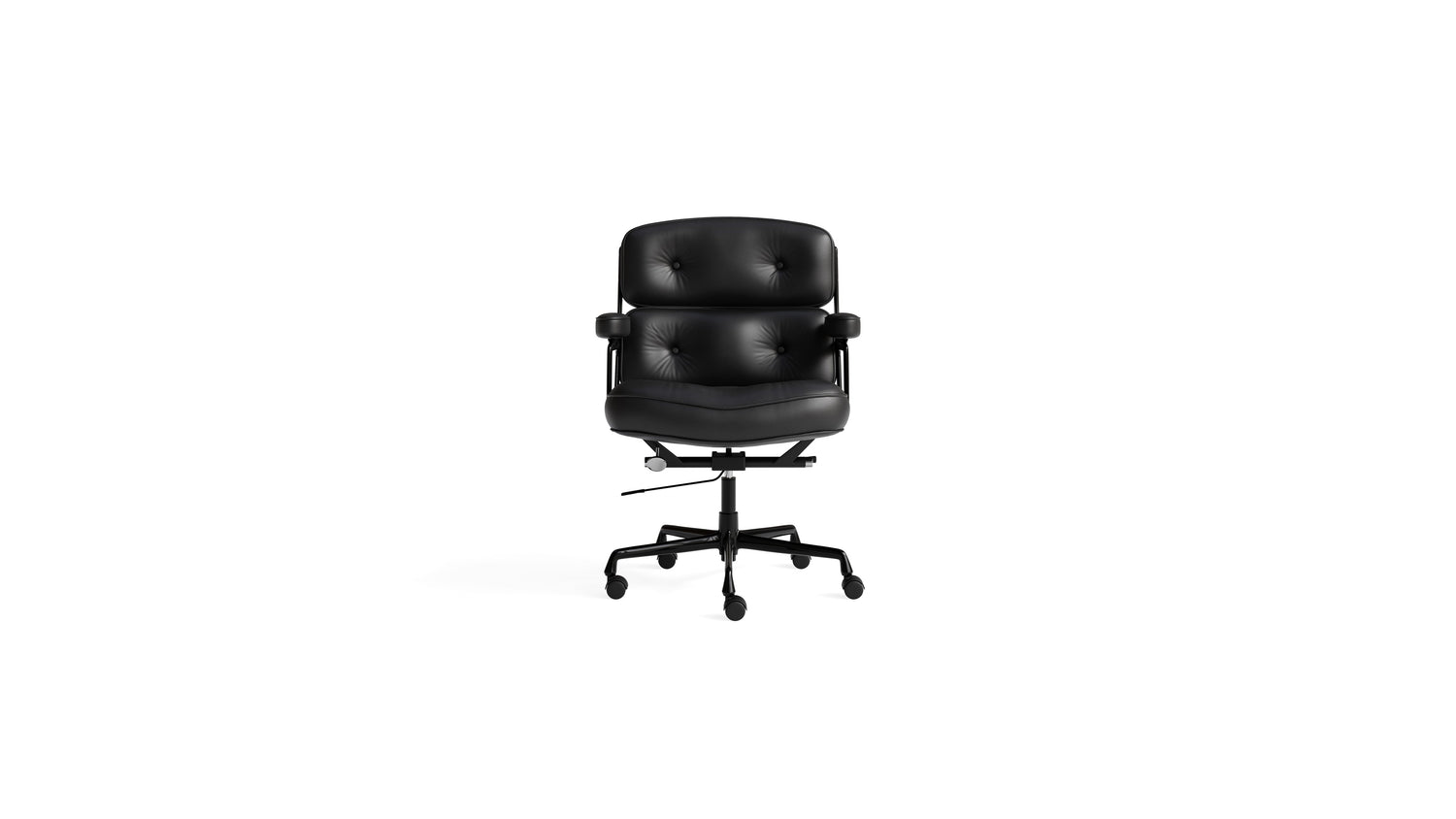
| Time-Life Lobby Chair | 1960 | Cast aluminium, leather |
| Chaise for Billy Wilder | 1968 | Cast aluminium, leather pads |
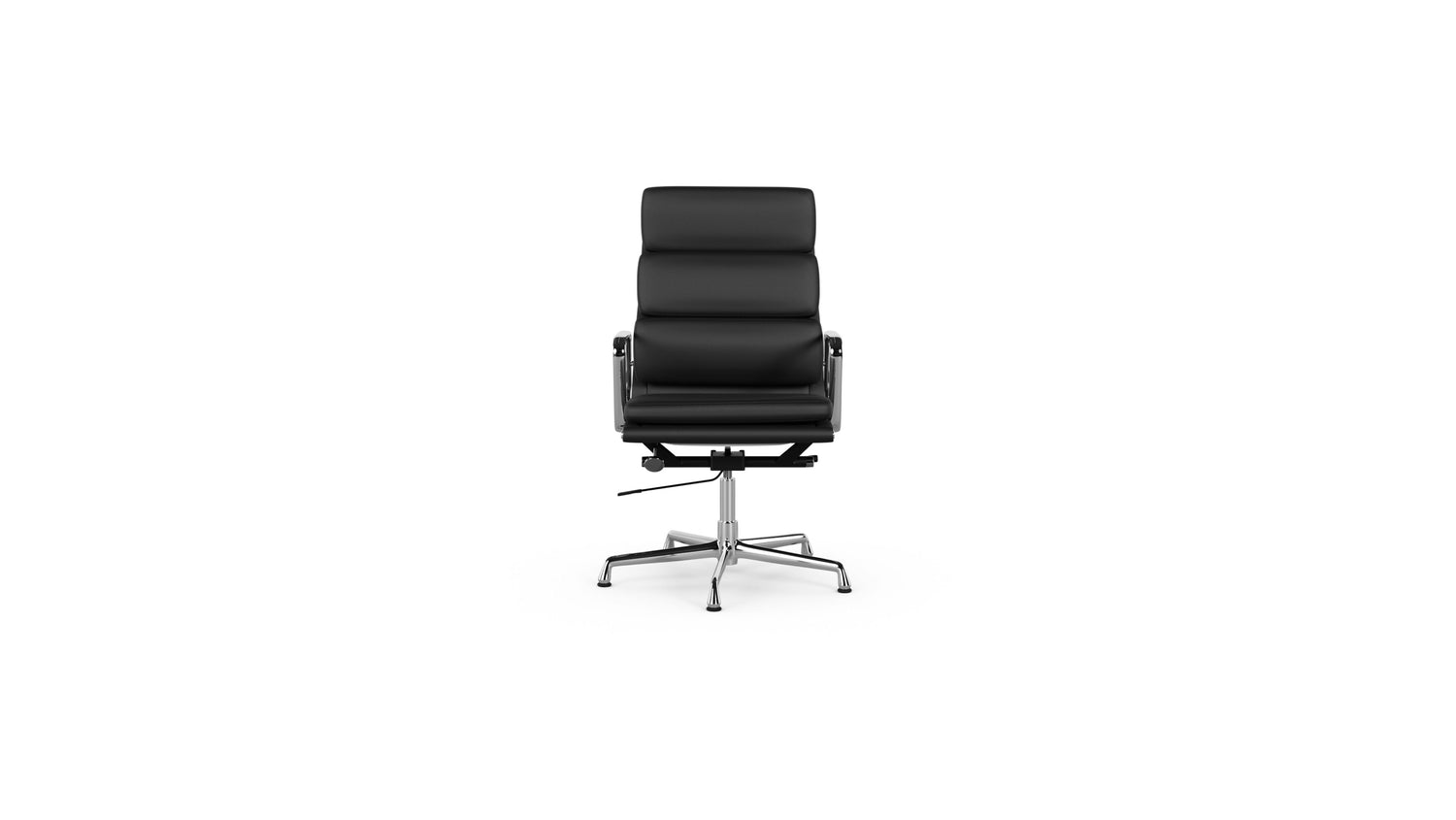
| Soft Pad Group | 1969 | Cast aluminium, padded leather |
The Moulded Plywood Chairs
The Museum of Modern Art put the plywood chairs in front of the public in June 1946, and they went on sale the same year as the first commercial return on five years of war work. Time called the LCW the chair of the century. Museum records describe the construction consistently: moulded plywood, usually a birch or ash veneer, finished in aniline dye, with rubber shock mounts. The Art Institute of Chicago gives the LCW as 67.9 by 56.5 by 57.2 centimetres and the DCW as 73.7 by 49.5 by 42.6, which is small by the standards of contemporary seating.
Seat and back are separate mouldings rather than one shell, and the division was forced before it was chosen. A single plywood body split along the line of tightest curvature, so the form was cut at the point of failure and the two halves carried on a spine. The office came to regard that as the honest use of the material rather than a concession, and the technique behind it, which they called the Eames process, was patented.
What do LCW, DCW, LCM and DCM mean?
The letters describe the configuration. L is lounge height and D is dining height, C is chair, and the final letter gives the leg material, W for wood and M for metal. An LCW is therefore a lounge chair with wooden legs and a DCM a dining chair with metal ones. The moulded seat and back are shared across all four.
What are shock mounts and why do they perish?
Shock mounts are rubber discs bonded between the plywood shells and the frame, and they are the reason a rigid plywood chair is comfortable to sit in for any length of time. The seat and back flex a few millimetres under load rather than presenting a fixed surface.
Rubber bonded to wood also ages, and on chairs from the 1940s and 1950s a detached mount is the most common fault a buyer encounters. The repair is routine, and the condition of the mounts is one of the first things a specialist checks when dating an example.

The Shell Chairs and La Chaise
In 1949 the Museum of Modern Art granted the Eames Office five thousand dollars to lead a research group into low-cost furniture, on the strength of their earlier win, and the resulting competition entry was a single-piece shell offered in armed and armless versions on a range of bases. The shell was stamped steel, coated in neoprene so that the metal would not become uncomfortably hot or cold. It took second place, and the judges reserved most of their praise for the base system rather than the seat.
Production then stalled on cost. Tooling a steel stamping press meant eighty thousand dollars for a design with no precedent in the market, and the manufacturer declined.
Why did the shell chairs end up in fiberglass?
Because it was the other wartime material they understood. Fiberglass had been invented in the 1930s and its use through the war was confined to military work, most visibly in radomes, the moulded cones fitted to aircraft to shield antennas from the weather. It cost little to form, stayed indifferent to heat and cold, and needed no coating at all, which removed the neoprene problem in a single step.
A fabricator named John Wills made two proof-of-concept shells for them. One of those two survives and is on display at the Henry Ford Museum, where Charles and Ray are exhibited alongside Thomas Edison and the Wright Brothers. Production went to Irv Green and Sol Fingerhut of Zenith Plastics, who until then had made nothing but radomes, and who were sufficiently persuaded by the design to pay half the five-thousand-dollar tooling bill themselves.
What was difficult about making them?
Not the shape, by Charles's account. The object was to take a material developed for aircraft, where the industry could absorb enormous tooling costs, and put it under an ordinary person at an ordinary price. The obstacle turned out to be consistency rather than form. "At first we had very clear ideas of the kind of surface we wanted to maintain," he said, "but eventually we realized that anything would do just as long as it was uniform. Uniformity, uniformity, eventually we realized that this was what we were striving for, and that actually it was the toughest thing to get."
The chairs were shown to the trade at the Chicago Merchandise Mart in January 1950 and went on public sale through a New York retailer whose newspaper advertisement billed them as the airplane plastic chair. The rocking version reached the public at $9.88.
Why is the colour in the material rather than on it?
Fiberglass had never been made to be looked at. Radomes were left the natural colour of the mixture, since nobody cared what a component inside an aircraft nose looked like, and there was no reason for a pigment range to exist. Charles and Ray spent dozens of evenings at the Zenith factory mixing combinations until they had colours that would sit properly in a house or an office.
Three were ready for the launch: greige, elephant hide grey and parchment. The range reached about thirty over the following years. In every case the pigment went into the resin rather than onto the surface, which is why a shell from the 1950s fades rather than chips. The office preferred integral finishes for exactly that reason, since an applied finish eventually comes off and an integral one ages instead.
Charles described the process itself in a letter to an engineer friend: short lengths of glass fibre blown into a cyclone and drawn against a screen by air, the resulting preform set between matched dies, polyester resin poured in, and the whole thing cured at 250 degrees Fahrenheit for five minutes.
What bases were made for the shell chairs?
| Base | Construction | Intended use |
|---|---|---|
| Eiffel | Welded wire lattice on four legs | Dining and occasional |
| Dowel | Four wooden legs with wire bracing | Domestic dining |
| Rocker | Wire base on steam-bent runners | Lounge and nursery |
| Stacking | Tubular steel, nests vertically | Contract and institutional |
| Swivel | Cast pedestal, often castored | Desk and office |
| Low wire | Shallow wire frame | Lounge |

What is La Chaise?
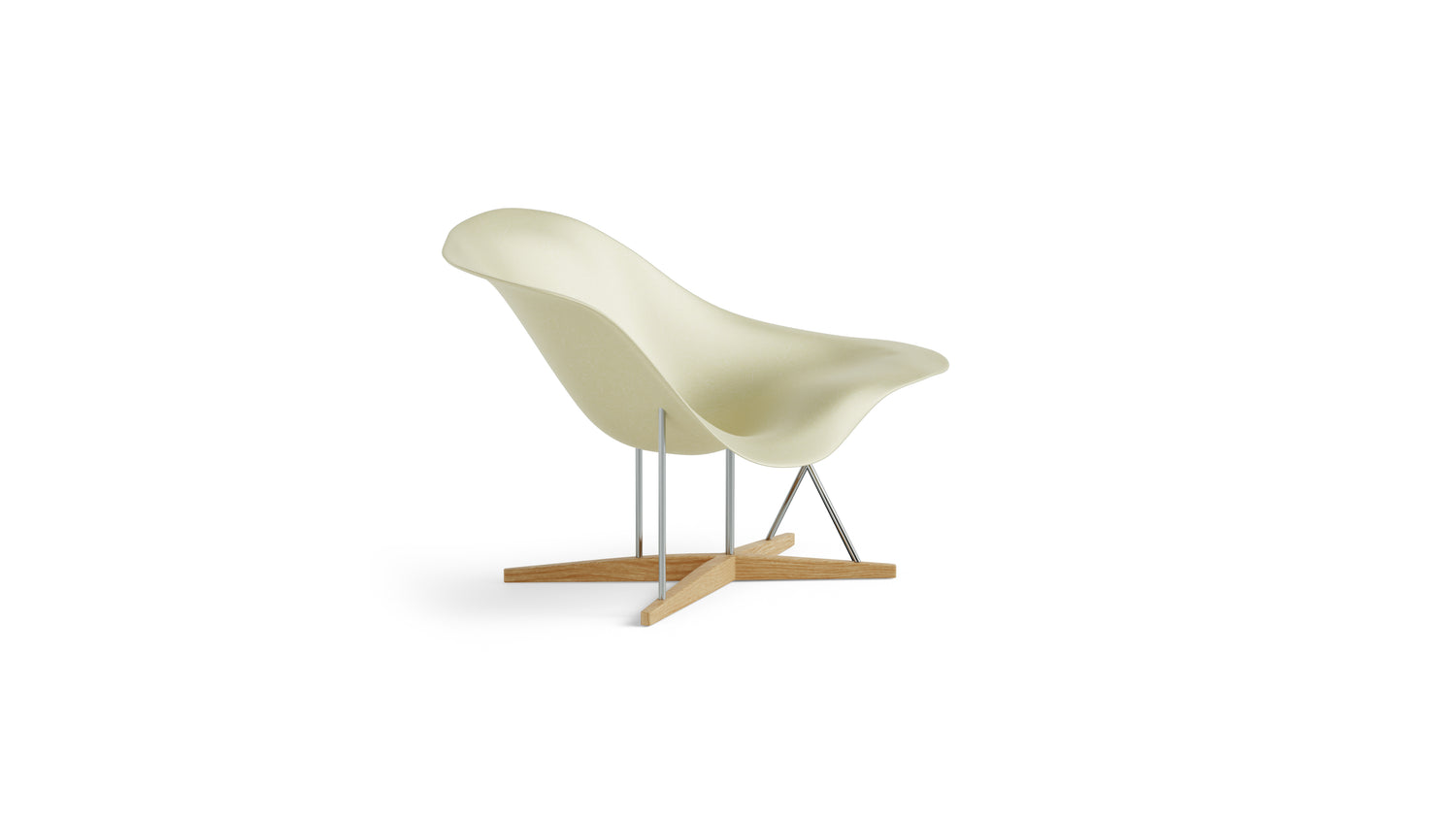
La Chaise was the office's second entry to the same competition, and it met the brief for low-cost furniture by ignoring it entirely. A single moulded fiberglass form, split by a slot and carried on a splayed steel and oak base, it takes its shape from Gaston Lachaise's 1927 sculpture Floating Figure.
It won no prize. The judges thought it too specialised in use and too expensive to manufacture, while noting that the moulded construction was striking, good-looking and inventive. It stayed a prototype for forty-two years and entered production in 1990.

The Wire Chairs
The wire chairs of 1951 are the second and last time the office produced a one-piece surface, and they are usually treated as a footnote. They matter more than that, because the upholstered versions set a steel wire framework beneath separate cushioned pads rather than upholstering the seat itself.
The Eames Office describes the high-back wire chair of that year as a step on the road toward the lounge chair of 1956. Read in sequence the line is clear enough: a frame that carries pads instead of absorbing them is the arrangement the 1956 chair would eventually resolve in plywood and leather. The Hang-It-All of 1953, four angled wire hooks welded to a rectangular frame, came out of the same welding work.
The 1956 Lounge Chair and Ottoman
By 1956 the office had three established lines in the market, in moulded plywood, moulded plastic and upholstered wire, all of them designed around volume and low cost. The Lounge Chair 670 and Ottoman 671 went the other way. Charles described the starting point as a modern version of the nineteenth-century English club chair, and the pair sold at $310, equivalent to roughly $3,100 today, against $9.88 for the rocking shell chair six years earlier.
How is the 1956 Lounge Chair constructed?
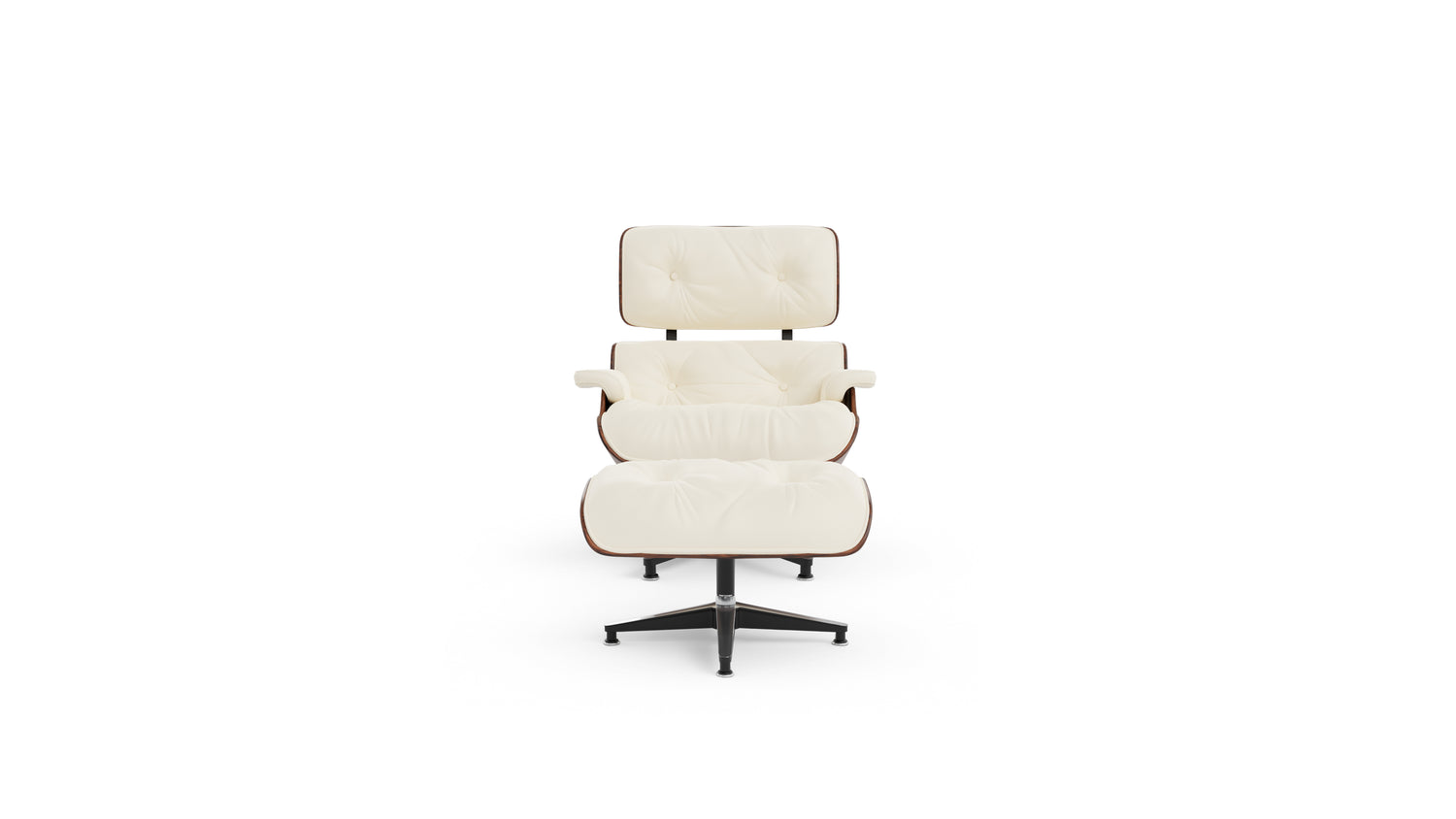
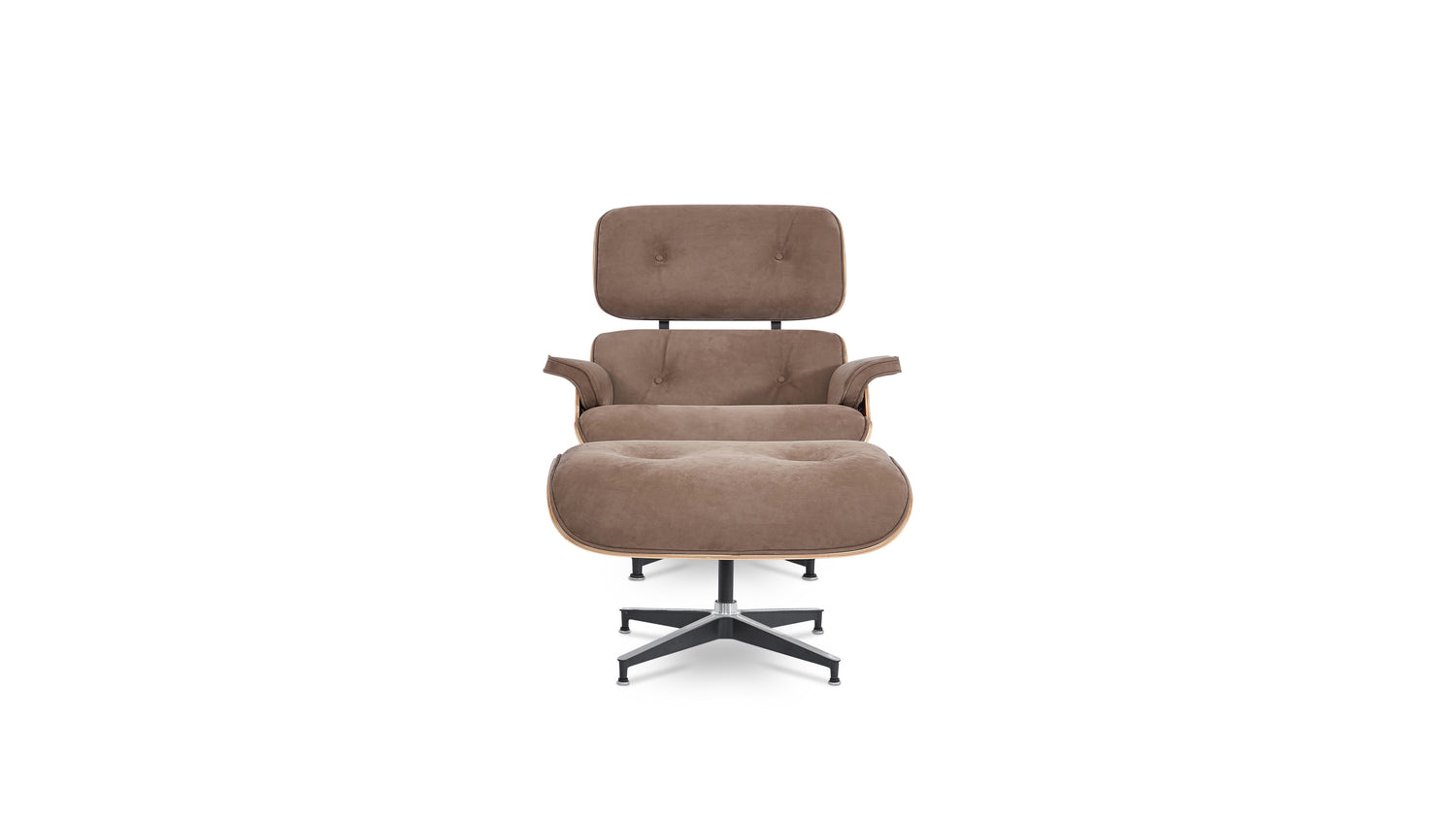
Three curved plywood shells carry leather cushions, joined by aluminium spines and rubber shock mounts, on a five-star cast aluminium base that pivots. MoMA, which acquired an example in 1960, records the materials as moulded rosewood plywood, leather, cast aluminium, rubber shock mounts and stainless steel glides, with the chair measuring 83.8 by 85.7 by 83.8 centimetres.
The economy is easy to miss under the rosewood. Counting the ottoman, the whole design uses only two standard plywood parts, because the two back panels are identical to each other and the chair seat and ottoman seat are identical to each other. A luxury object was built from two repeated components, and the first graphic the office ever produced showed the chair disassembled into its pieces.
What are the cushions filled with?
The first examples were filled with feather and down, and Charles and Ray wrote the hang tag explaining the choice. Production moved on. Herman Miller began blending foam into the fill in 1960 and dropped feathers altogether around 1971, after years of use showed the cushions flattening and losing their shape. Foam is what holds the profile the chair was drawn to have, and every chair built since, by Herman Miller in America and Vitra in Europe, has used it.
Our reproduction of the Eames Lounge Chair is built with moulded injected foam cushions wrapped in Dacron. It is offered with a palisander rosewood, black ash, white ash, white oak or walnut shell, fabric, aniline leathers or nubucks, and a choice of American or European released base design.
Why was it shown on television?
Charles and Ray presented the chair themselves on NBC's Home show in 1956, with Arlene Francis calling it quite a departure from their earlier work. Furniture was not ordinarily launched to a national audience on daytime television, and the original broadcast footage survives.
The Aluminium Group and After

The Aluminium Group began in conversation rather than in a brief. Alexander Girard called on Charles and Ray in 1958 to talk about furnishing the Miller House in Columbus, Indiana, which he had just completed with Eero Saarinen, and complained that he could find no outdoor furniture of the quality the house deserved. Charles described the sequence afterwards. "You start on a close human scale," he said. "Here is a friend who has done something. He needs something for it, and you become involved." The Eameses called the result the leisure group, or the indoor-outdoor group.
Their answer abandoned the shell altogether. Two cast aluminium side members hold a panel stretched between them under tension, so the material is the seat and there is no frame beneath it. Charles remembered working the idea out as a cross section drawn on the back of an envelope, in a sketch under two inches square. It was the first time they used aluminium structurally, and the weight tells the story: a comparable upholstered armchair of the period weighed between forty and sixty pounds on a wood or steel frame, and this one weighed eighteen and pivoted.
How does the seat hold its shape without a frame?
The pad is a sandwich. A quarter-inch vinyl foam core, two layers of a woven backing over it, the whole enclosed in the outer fabric and bonded into a single unit by heat seals running across the width at intervals of one and seven eighths of an inch. The seals stop the padding from migrating, and the sewn edges are reinforced.
That unit then sits in channels cut into the two side members and is held by tension alone, generated by the outward spring of the frame, with screws and aluminium washers securing the four corners. The arrangement is the reason the seat does not sag in normal use, and it is worth understanding before buying any sling chair, since a pad that relies on the frame's spring will behave differently from one stretched over a fixed rail.
Whether that holds up is a matter of record rather than argument. The Miller House passed to the Indianapolis Art Museum in 2015, and the Aluminium Group chairs installed there in 1958 were still in daily use on the day it changed hands. They are now in the museum's permanent collection.
What is the Time-Life Lobby Chair?
A commission from 1960 for the lobby of the Time-Life Building in New York, using the same aluminium construction in a lower and more heavily upholstered form intended for people waiting rather than working. It is the least copied of the aluminium designs and the one most often mistaken for the 1956 chair in photographs, where the base and the seat depth give it away.

Why is the 1968 chaise so narrow?

Because the director Billy Wilder asked for it that way. Filming on location in 1955, he had discovered he could take a useful nap on a plank laid across two sawhorses, and he told Charles and Ray, who were friends, that what he wanted was a narrow office couch. They gave him the first one thirteen years later.
The chaise is seventeen and a half inches across. Lie down on it with your arms folded and they slip off the sides within a few minutes, which wakes you, so the narrowness functions as an alarm clock. Six leather pads sit on an aluminium frame with a single crossbar. It was never conceived as a commercial product.
It is also not the oddity it looks. The Aluminium Group was the first of what the office called its sling seating, where a tensioned pad does the work a frame would normally do, and the Soft Pad Group of 1969, the tandem seating built for airports, and this chaise all descend from it. A conversation about garden furniture in 1958 produced the construction that a film director slept on ten years later.
The Eames House
Case Study House No. 8, in Pacific Palisades, was their own home from Christmas Eve 1949 until the end of both their lives, and it remains furnished as they left it. The Case Study programme was run by Arts & Architecture under John Entenza, who commissioned architects to design affordable modern houses from materials that were actually available after the war, and who built House No. 9 for himself on the adjoining plot.
The Eames answer was to order the entire structure from industrial catalogues. Standard light factory steel framing forms a web infilled with transparent glass, translucent glass and opaque panels in colour. Construction began in February 1949, and the foundation and steel frame went up in sixteen hours.
Why was the first design abandoned?
The original scheme, drawn with Eero Saarinen, was a bridge house spanning the meadow and cantilevered out from the slope. The steel was ordered and delivered, then sat on the site through a long delay, and during the wait Charles and Ray changed their minds about the site itself. They had grown attached to the meadow and the row of eucalyptus, both of which the bridge house would have crossed.
The second design runs along the slope instead, tucked behind a retaining wall, and used almost all the same catalogue parts with one additional steel beam. It enclosed more space with less material and left the meadow where it was.
Can the Eames House be visited?
Yes, by appointment. The house was designated a National Historic Landmark in 2006 and is maintained by the Eames Foundation, which works with the Getty Conservation Institute on a programme intended to preserve it for two hundred and fifty years. The Getty published a conservation management plan for the building in 2019, and the original drawings are held by the Library of Congress.
Films and Exhibitions
The office made more than a hundred short films, of which Powers of Ten, produced for IBM in 1977, is the best known. It travels outward from a man lying in a Chicago park to the limits of the observable universe directly above him, then back down into the microscopic world inside his hand, changing scale by a factor of ten every ten seconds. The Library of Congress holds it, and the National Film Preservation Board has published on it.
The largest of these projects was not a film in any ordinary sense. For the American National Exhibition in Moscow in 1959, part of the cultural exchange between the two countries and the setting for the Nixon and Khrushchev kitchen debate, the Eameses assembled Glimpses of the U.S.A. More than two thousand two hundred still and moving images played at once across seven screens, each of them thirty feet wide. Whatever else the office was, it was not a furniture studio that occasionally did other things.
Exhibition design ran throughout. Mathematica: A World of Numbers and Beyond, built for IBM in 1961 and installed in Los Angeles and Chicago, is still operating. The storage units of 1949 were first shown in the Eames room of Alexander Girard's An Exhibition for Modern Living at the Detroit Institute of Arts, and the toys, including The Toy of 1951 and the House of Cards of 1952, came out of the same rooms in the same years as the chairs.
Where the Designs Stand Today

Eames furniture is held by the Museum of Modern Art, the Art Institute of Chicago, the Los Angeles County Museum of Art, the Victoria and Albert Museum, Cooper Hewitt, SFMOMA, the Denver Art Museum and the RISD Museum, among others. The Library of Congress holds the office's papers, roughly a million items. The Henry Ford Museum exhibits Charles and Ray as inventors.
The plywood, fiberglass and 1956 designs have been in production more or less continuously since they were introduced. Fifty years after the lounge chair appeared, in 2006, a scholarly book and a touring museum exhibition were devoted to that single piece.
Why are these designs still made?
The manufacturing logic has not been improved on. A moulded shell carried on a separate base remains an efficient way to build a chair, compound-curved plywood remains a good way to support a back, and a panel held in tension remains a light way to make a seat. The forms followed from the methods, and the methods still hold.
The proportions help. These are small pieces by the standards of contemporary furniture, the shell chairs stack, and the 1956 chair occupies less floor area than its visual weight suggests.
What should you look at when choosing a reproduction?
Examine the plywood first. A moulded shell should show even veneer thickness at the exposed edge with no gaps between plies. Check that shock mounts are rubber bonded to the shell rather than screwed through it, since the bond is what allows the flex. Ask for the leather grade and its thickness in millimetres, ask what the cushions are filled with, and establish whether the base is cast or pressed and how it is finished.
Our Eames pieces are reproductions of the original Charles and Ray Eames designs, and the materials, dimensions and finish options for each are listed on its product page.
Frequently Asked Questions
Was Ray Eames a man or a woman?
Ray Eames was a woman, born Bernice Alexandra Kaiser in 1912, and she used the name Ray throughout her adult life. She trained as a painter under Hans Hofmann for six years, was a founding member of the American Abstract Artists, and was an equal partner in the office from 1941 until her death in 1988.
Were Charles and Ray Eames related?
They were married rather than siblings. They met at Cranbrook Academy of Art in 1940 and married in Chicago the following year, and the shared surname is Ray's married name.
What is the most famous Eames chair?
The Lounge Chair 670 with its Ottoman 671, introduced in 1956. The moulded plywood LCW of 1946 and the fiberglass shell chairs of 1950 matter more in manufacturing history, since they solved problems nobody had solved before, but the 1956 chair is the one most people picture.
What is an Eiffel base?
The welded wire lattice fitted beneath the moulded shell chairs, named for its resemblance to the ironwork of the Eiffel Tower. The shell above it is the same component used on dowel legs, rockers, stacking frames and swivels, so only the base changes.
What wood was used in the 1956 Lounge Chair?
Rosewood veneer over moulded plywood. Rosewood is now restricted under CITES, and current production uses walnut, ash, oak or palisander rosewood. Ours is offered in palisander rosewood, white ash, black ash, white oak and walnut.
How can an original Eames chair be dated?
By the base, the mounts and the label. Early plywood chairs used a five-ply construction and a different shock mount adhesive from later runs, fiberglass shells from the 1950s show visible glass strands when held against the light, and labels changed several times across the decades. Auction houses and specialist dealers publish dating guides, and an early example will normally carry provenance.
Which Eames chair suits a desk?
The Aluminium Group and the Soft Pad Group were designed for it, with a swivel base and a tensioned seat that takes the sitter's shape. A shell chair on a swivel base also works. The 1956 Lounge Chair was never meant for a desk, sitting too low and too far reclined to work at a surface.
Where can Eames work be seen in person?
Museum collections in New York, Chicago, Los Angeles, London and San Francisco hold pieces, the Henry Ford Museum exhibits the couple as inventors, Mathematica remains on display, and the Eames House in Pacific Palisades can be visited by appointment.
Charles and Ray Eames at Archetype Forms
Thirty-seven years of work produced a body of furniture that has stayed in production because the reasoning behind it was sound. The forms were arrived at by building things and sitting in them, the part counts were kept low on purpose, and the construction was left visible so that a chair could be repaired rather than replaced.
Our Charles & Ray Eames collection covers the 1956 Lounge Chair and Ottoman, the moulded plywood lounge and dining chairs, the moulded fiberglass shell chairs, La Chaise and the Lobby Chair. Each is a reproduction of the original Charles and Ray Eames design, with materials, dimensions and finish options listed on its product page.
Contact us for help selecting a piece or comparing finishes.